On Monday, U.S. President Donald Trump signed an executive order on quantum computing at the White House, mandating the acceleration of high-performance quantum computer development for scientific research. The order also aims to enhance government systems’ capabilities to address related cybersecurity threats, thereby strengthening America’s leading position in this critical technological race.
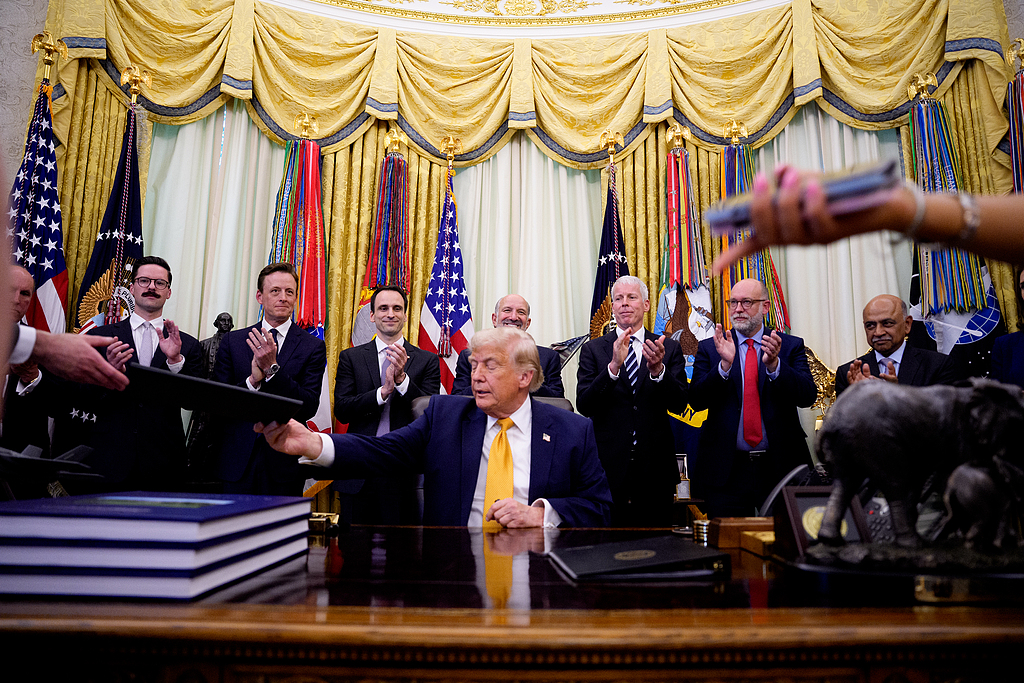
During the signing ceremony, Trump specifically commended IBM CEO Arvind Krishna for his leadership. “IBM CEO Arvind Krishna is a remarkable individual doing exceptional work. You are doing a fantastic job,” Trump remarked to the executives present.
A $500 million fund. Key Quantum Computing Executive Orders The core of the White House event was to advance U.S. dominance in next-generation computing, sensing, and networking technologies. President Trump signed two sweeping executive orders to accelerate the development of domestic quantum infrastructure: 1. Five-Year Sprint Program: The first order launches a government-backed national initiative aimed at building a fully operational quantum computer capable of advanced scientific computation, equipped with quantum networks and sensors, within the next five years. 2. 2031 Encryption Transition: The second directive requires federal agencies to migrate all computer systems to post-quantum cryptography by 2031, a critical cybersecurity measure designed to protect government data from future quantum decryption threats. The gathering was a veritable who’s who of the tech elite. Representing the industry alongside Krishna were Google President Ruth Porat, Inflection CEO Matthew Kinsella, and Nobel laureate and quantum physicist John Martinez Goldman. Before signing the new directives, Trump acknowledged his administration’s prior efforts in this field, specifically citing the National Quantum Initiative Act of 2018. That landmark legislation ultimately led to a doubling of federal investment in domestic quantum research and development.